
Five Myths That Weaken Documentation in Your CV & IR Program
Every program has a story it tells itself about why revenue leaks happen. Usually, the story points to a coder missing something, a payer changing a rule without warning, or a random audit identifies an issue. Those stories are appealing because they put the problem outside the program's own walls, something that happened to them rather than something built into how they work.
The real pattern is almost always upstream of all that, in how a case got documented in the first place. It's rarely one dramatic mistake. More often it's a habit repeated across dozens of cases, invisible until someone finally looks closely enough to notice. By then it's not a coding or billing problem, it's a documentation problem that just happened to surface somewhere else.
Here are five myths worth checking against what's actually happening in your CV & IR program right now.
Myth 1: If a claim gets approved, the documentation was fine.
Getting paid means a claim cleared the payer's initial checks. It doesn't mean the documentation behind it would hold up under a closer look, however.
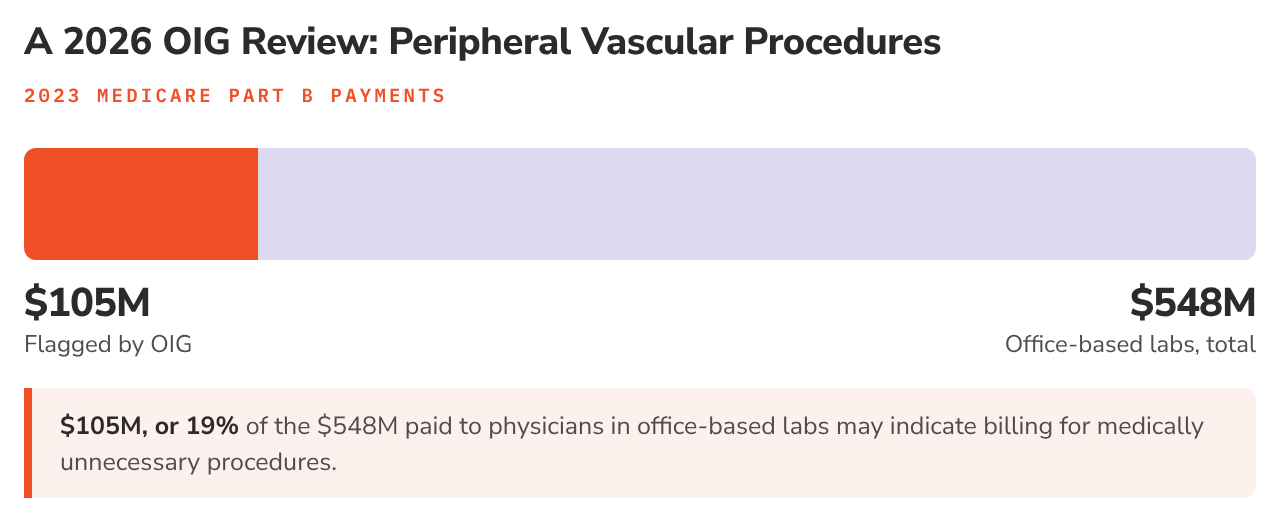
In May 2026, OIG reviewed Medicare Part B billing for peripheral vascular procedures, angioplasty, stenting, and atherectomy. Medicare paid more than $1 billion for these procedures in 2022 across all care settings. In 2023, office-based labs alone accounted for $548 million. Of that office-based total, OIG identified about $105 million, or 19%, in payments that may indicate billing for medically unnecessary procedures. The report doesn't outright claim wrongdoing; it flags billing patterns that deserve a closer look. CMS has agreed to monitor these procedures and follow up with the providers identified.
What to do about it? Ask whether someone with only the record could see why the procedure was necessary, what was done, and that every element the code requires is there. If they couldn't, the gap is in the documentation, whether or not the claim got paid. Reading a few paid cases this way each month shows quickly whether the documentation is carrying its own weight.
Myth 2: If something's missing from the documentation, a query will catch it.
It's a comfortable assumption for a lot of programs that if a provider leaves something out, the CDI or coding team will just query them afterward and get it fixed before the claim goes out. The query process feels like a safety net, so the documentation itself doesn't have to be perfect the first time.
That safety net is narrower than it looks. AHIMA and ACDIS guidelines say a query can't lead the provider toward an answer; it has to rest on clinical indicators already in the record. So a query follows up on what the record already points to, not everything that's actually missing. Timing is the other limit. A query comes after the report is written, so the gap exists before anyone asks.
What to do about it? Build specificity into the documentation itself rather than relying on a query to backfill it. Save queries for the genuinely ambiguous cases. When the same question keeps coming back, that's a sign the report needs to answer it the first time.
Myth 3: Once you learn the new codes, you're set for the year.
The January 2026 CPT overhaul of lower extremity revascularization coding was the most significant overhaul to that territory in over a decade. That's the kind of update that gets attention, gets trained on, and gets remembered.
The updates that continue to happen in the background all year long don't get the same attention. CMS's guidance on -59, -XE, -XP, -XS, and -XU modifiers was updated as recently as April. Category III CPT codes are now updated quarterly, as are some HCPCS Level II codes from CMS. NCDs can change guidance at anytime. Each of these can change what a report has to say to support the code.
Payer rules shift too. Some payers removed prior authorization requirements for certain imaging and cardiology procedures while others added new ones, so rules that are in effect in January may not last through summer. Learning the big change once leaves the smaller ones uncovered, and that gap is where denials quietly accumulate.
What to do about it? Put the small changes on the calendar. Once a quarter, someone checks code updates, CMS guidance, and each payer’s prior authorization requirements, and tells the team what changed. The big overhaul gets a training session, and the small updates need a recurring one.
Myth 4: Coding happens after the documentation is finished.
Most workflows still treat coding as a downstream step: the provider documents, the report gets finalized, then the coder codes, and billing submits. It’s a logical sequence, and everyone in it is doing their job.
The gap is in what that order leaves out. Nobody is checking whether the documentation supports the code until the it is already locked, so a missing element can travel all the way to the claim before anyone sees it. Catching a missing element of selectivity, territory, or medical necessity while the case is still open is a fundamentally different outcome than catching it after a denial.
AHIMA’s practice brief on CDI reviews describes checking documentation at several points, including during the encounter and before the claim is submitted. For services covered by an NCD or LCD, it says that work should begin when the service is planned.
What to do about it? Move the review to the point where the provider can still add what's missing. That's the idea behind prospective clinical documentation integrity review, a practice AHIMA has outlined for reviewing the report before the record is finalized. Start with the elements the code depends on, and decide who looks and when.
Myth 5: More documentation always means safer documentation.
When providers are worried about denials, the instinct is often to write more, with longer procedure notes, more descriptive language, and more detail on everything. It feels like a safer bet than writing less.
Payers aren't looking for volume. They're looking for specific, required elements, and Medicare contractors publish them. Palmetto GBA's coverage policy on endovascular management of peripheral arterial disease (LCD L40228), which includes office-based settings, is one example. Its billing and coding article lists what should be documented in the medical record, including renal function, diabetes, functional capacity, frailty, and previous revascularizations. For patients with more complex anatomy, it also calls for the rationale for choosing endovascular intervention over surgical revascularization.
Quality registries ask for specific data points too. NCDR registries define each data element in a data dictionary, abstract it from the medical record, and audit submissions against the source documentation.
A long procedure note that never states those elements is just as exposed as a short one. Specificity is what protects a claim. Length on its own does nothing.
What to do about it? Define what a complete note looks like for each procedure type. Start from the payer policies and registry elements that apply, turn them into a short list, and have providers write to it. A procedure note that covers every element holds up, no matter the length.
The Common Thread
If it was approved, it was fine. A query will catch it. That was covered in training. Coding will review it. More detail is safer.
These five myths look different, but they answer one question the same way. If the report misses something, who catches it? None of them is about carelessness. Each one assumes someone or something else will. Sometimes that's true. But nothing can put back what was never written down. Payers, auditors, and registries never see the procedure. They see the record of it, so to everyone outside the room, the documentation is the procedure. The report is the first checkpoint that matters, and a record becomes defensible when it's written, not when it's reviewed.
Curious where your own documentation stands against this list? Reach out to our ZHealth Documentation team and we'll walk through it with you.
The Etch Effect
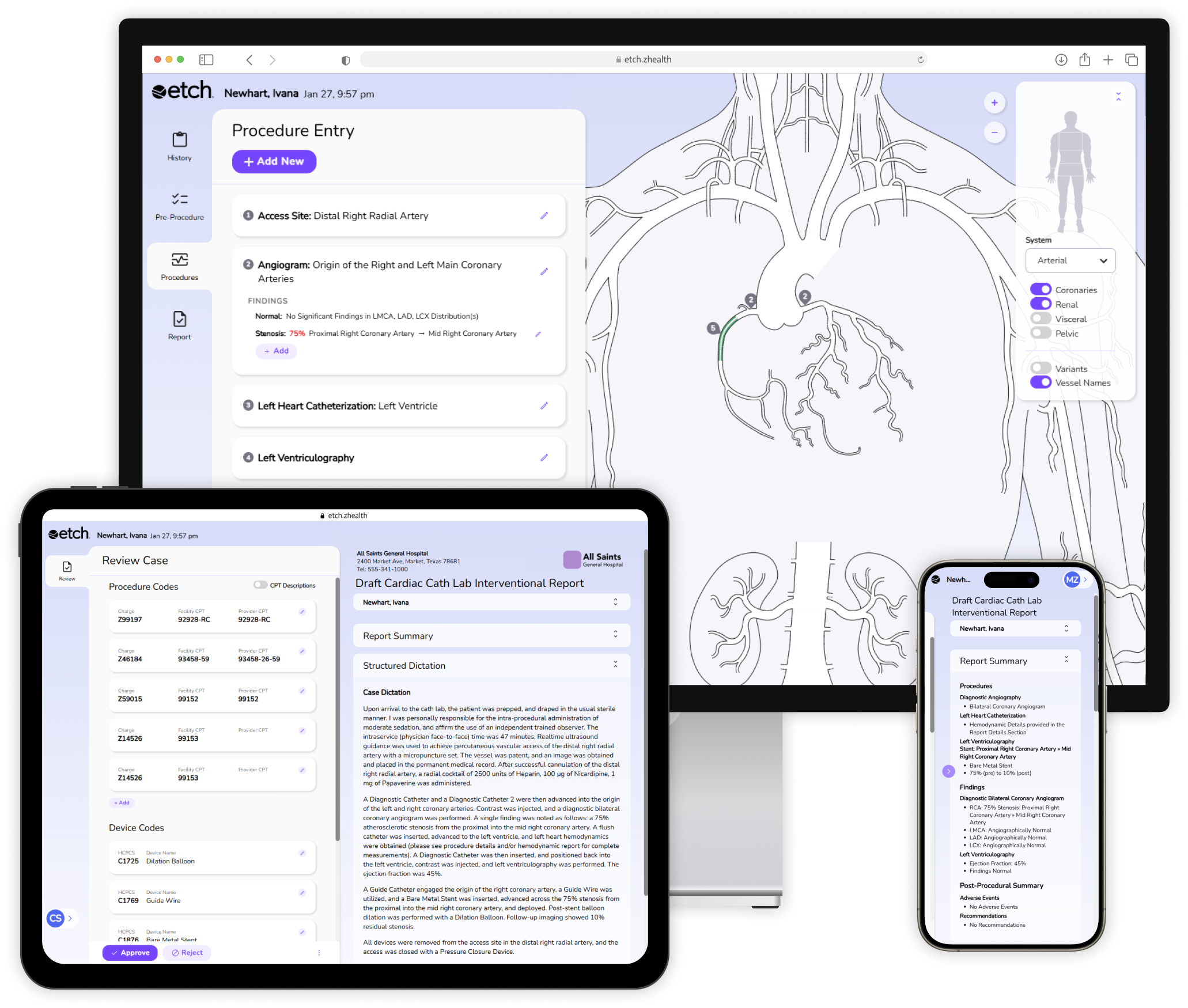
Etch is built for complete, accurate documentation from the start. Etch-Guided Documentation prompts the provider to document every required clinical element of the case as they go. Etch’s patented, autonomous code engine then generates the codes in real time, with 99%+ accuracy. When CPT codes or modifier guidance change, Etch updates automatically, so no provider has to relearn what changed. Before the report goes out, Etch flags any issues to the provider or compliance team, so a missing element is caught while the case is still open instead of after a denial.
References
HHS Office of Inspector General, "Utilization Trends and Medicare Part B Billing for Office-Based Peripheral Vascular Procedures Raise Questions About Program Integrity," May 2026. oig.hhs.gov
Cardiovascular Business, "Trump Administration Questions Vascular Care Provided by Surgeons, Cardiologists and Radiologists," 2026. cardiovascularbusiness.com
Centers for Medicare & Medicaid Services, "Proper Use of Modifiers 59, XE, XP, XS & XU," Medicare Learning Network, MLN1783722, April 2026. cms.gov
UnitedHealthcare, "Removal of prior authorizations for radiology and cardiology procedures," effective January 1, 2026. uhcprovider.com
Centers for Medicare & Medicaid Services, Medicare Coverage Database, "Billing and Coding: Endovascular Management for Peripheral Arterial Disease of the Upper and Lower Extremities" (A60247), supporting LCD L40228, effective April 12, 2026. cms.gov
"The National Cardiovascular Data Registry Data Quality Program 2020: JACC State-of-the-Art Review," Journal of the American College of Cardiology, 2022. jacc.org
AHIMA/ACDIS, "Compliant Clinical Documentation Integrity Technology Standards." acdis.org
AHIMA/ACDIS, "Guidelines for Achieving a Compliant Query Practice," 2026. acdis.org
Society of Interventional Radiology, "Coding Q&A: New and Revised Codes for 2026," IR Quarterly. sirweb.org